
Box Cricket Rules: Nets, Roof, Overs and Team Size Explained
Box cricket rules explained: team size, overs, underarm or overarm bowling, net and roof rules, catches off the net and LBW, plus a checklist for the toss.
Box cricket is cricket squeezed into a netted cage: a small turf, nets on every side, often a net roof, and matches that have to finish inside a one-hour slot. It is how a lot of city cricket gets played now, from weekend games with friends to office leagues.
There is no official rulebook. Every venue and league writes its own house rules, and most arguments on a turf start because two teams assumed different ones. This guide covers the rules most boxes use, where they usually differ, and a checklist to settle before the toss.
Box cricket rules at a glance
The usual setup, if your venue or league hasn't said otherwise:
| Rule | What most boxes do |
|---|---|
| Players | 6 to 8 a side, sometimes with 1 or 2 substitutes who only field |
| Overs | 5 to 8 overs an innings, sized to fit the booked slot |
| Bowlers | 1 or 2 overs each, so most of the team bowls |
| Bowling action | Underarm in many leagues, overarm in others. Agree it first |
| Ball | Tennis ball or tape ball |
| Far (front) net | Hit it on the full for 6, often 4 after a bounce |
| Side nets | Fewer runs than a straight hit. The exact number varies most of all |
| Roof | Often a dead ball, or not out unless caught straight off the roof |
| Catches off a side net | Usually not out |
| LBW | Usually not given |
| Wide or no-ball | 1 run and the ball is bowled again |
| Tie | Super over |
What is box cricket?
A box cricket court is a rectangle of artificial turf closed in by netting, usually with a roof net so the ball can't leave. The pitch runs down the middle. Behind the bowler is the far net (some turfs have a wall there), the side nets run along the off side and the leg side, and the back net sits behind the wicketkeeper.
Because the field is tiny and the ball can't go out, the nets and the roof do the job that boundaries do on a normal ground. That is why most box rules are really about one question: what happens when the ball hits the net?
You will also hear it called turf cricket or cage cricket. It is close to indoor cricket, but indoor cricket has a fixed rulebook, while box cricket is played on house rules.
Team size and substitutes
Most boxes play 6 to 8 players a side. Smaller turfs feel crowded with more, and the short innings means fewer people get to bat. Leagues often allow one or two substitutes, but a substitute usually only fields: they can't bat or bowl.
- Fix the squad before the toss. Many leagues allow no changes after it, except for an injury.
- A wicketkeeper is normally compulsory, though the gloves can change hands between overs.
- If one team is short, agree how it works before you start: does someone bat twice, or does the other side lend a fielder?
Overs, bowlers and the bowling action
How many overs in box cricket?
Most matches are 5 to 8 overs an innings, with knockout games and finals sometimes a little longer. The real limit is the slot: two innings, the toss and changeovers have to fit inside the hour you booked. Some leagues also give each side a fixed time to bowl its overs.
Overs per bowler
With so few overs, leagues cap each bowler at 1 or 2 overs. In a five-over game with one over each, five different players have to bowl, so nobody can hide a weak bowling side behind their quickest bowler.
Underarm or overarm?
This varies more than any rule apart from the nets. In a small box a full-pace overarm delivery gives the batter very little time, so many leagues make everyone bowl underarm, released from below the waist. Others allow normal overarm bowling, sometimes with a rule against bowling too fast. Settle it before the first ball.
- A full toss above the waist is a no-ball.
- With underarm bowling, a ball that bounces twice is usually a dead ball.
- Overstepping the front line is a no-ball, as in normal cricket.
- The bowler who starts an over finishes it.
Net and roof rules
This is where boxes differ most, so treat the table as a starting point, not a rulebook. The principle is the same everywhere: the harder and straighter the shot, the more it is worth.
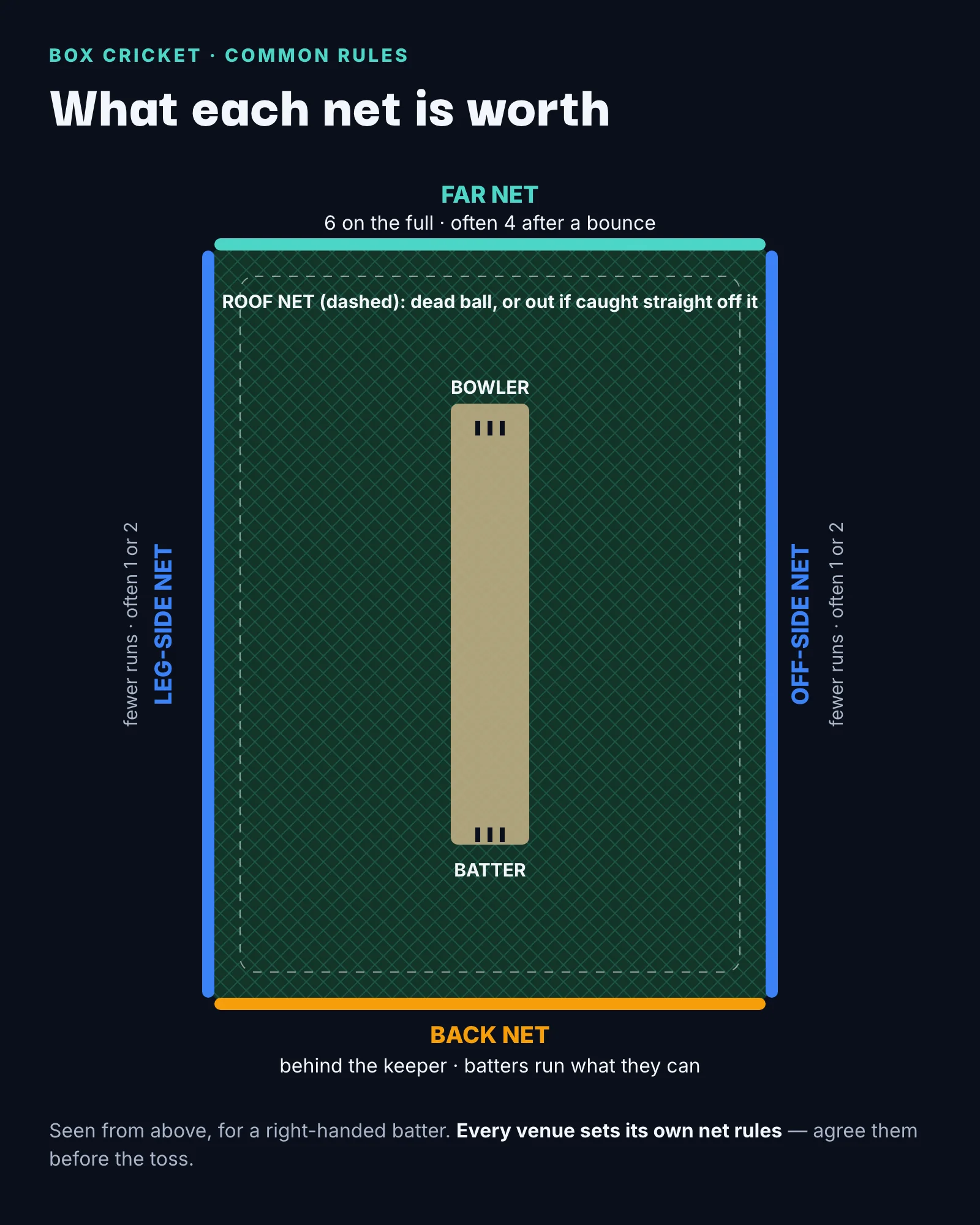
| Where the ball goes | Common rule | What to agree |
|---|---|---|
| Far net, on the full | 6 runs | Whether it must be a direct hit, or whether a ball that brushes a fielder still counts |
| Far net, after a bounce | 4 runs | Some boxes give fewer, or make the batters run |
| Side nets | Less than a straight hit, often 1 or 2. Some leagues give 4 for a shot that would have been a six | The exact runs for a hit on the full and after a bounce |
| Back net (behind the keeper) | Batters run what they can | Whether a hit behind the stumps earns fixed runs |
| Roof | Not out unless a fielder catches it straight off the roof, or a dead ball | Whether a roof hit is out, a dead ball or still in play |
| Ball stuck in the roof net | Dead ball, bowled again | Whether the batters keep any runs they ran |
In most boxes the net runs are fixed, so the batters don't need to run for them. A ball that stays inside the box without reaching a net is played like normal cricket: the batters run, and a fielder can run them out.
Catches and dismissals
Is a catch off the net out?
Usually not. A catch taken after the ball has touched a side net, the far net or the back net is not out in most leagues. The roof is the common exception: some leagues give the batter out if a fielder catches the ball straight after it hits the roof net.
A few groups play the gully-cricket one bounce, one hand rule, where a one-handed catch after a single bounce is out. It is a fun rule, but it is not standard, so only play it if both teams know.
Is LBW given in box cricket?
Usually no. There is rarely a neutral umpire, the pitch is short, and many games use underarm bowling, so most leagues leave LBW out. Bowled, caught, run out, stumped and hit wicket all still count.
The last batter
Leagues split on this. Some end the innings when only one batter is left, as in normal cricket. Others play last man stands: the last batter carries on alone, and must run every run without a partner. Agree which before the toss.
Retiring batters
Some friendly and office leagues retire a batter once they reach a set score, so the whole team gets a hit in a short innings. If you use it, agree the score and whether a retired batter can return at the end.
Wides, no-balls and fielding rules
- Wides and no-balls usually give the batting side 1 run, and the ball is bowled again. Some casual games give no run for a wide and just bowl it again.
- Runs off a no-ball, such as a net hit, are added on top of the no-ball run.
- Free hit: some leagues give one after a no-ball, many don't. Say which before you start.
- Fielding limits: many leagues cap how many fielders can stand behind the bowler, so a team can't pack the far net. Crossing that limit makes the ball a no-ball.
- Byes and leg byes work as in normal cricket.
Ties, results and box cricket leagues
A tie is usually settled by a super over: one over each, often ending early if the batting side loses two wickets. If that is tied too, leagues either play another super over or split the points. More in our super over rules.
Weekly turf leagues are normally run as a points table: points for a win, fewer for a tie or no result, and net run rate to separate teams on equal points. If you are organizing one, the Criconic tournament app updates the points table after every match.
Agree these rules before the toss
Copy this into your team group before the match. If both captains have answered every line, there is very little left to argue about.
- Players a side, and whether substitutes can bat or bowl
- Overs an innings, and the most overs one bowler can bowl
- Underarm or overarm, and whether there is a speed limit
- Runs for the far net, on the full and after a bounce
- Runs for each side net, and for the back net
- What happens when the ball hits the roof, or sticks in it
- Whether a catch off a net or the roof is out
- Whether LBW is given
- Runs for a wide and a no-ball, and whether there is a free hit
- Whether the last batter can bat alone, and whether batters retire at a set score
- How a tie is settled
- What happens if the slot runs out before the match ends
For an example of a full ruleset, the MI Paltan Turf League rules cover most of these points, with underarm bowling, one over per bowler and a roof-catch exception.
How to score a box cricket match
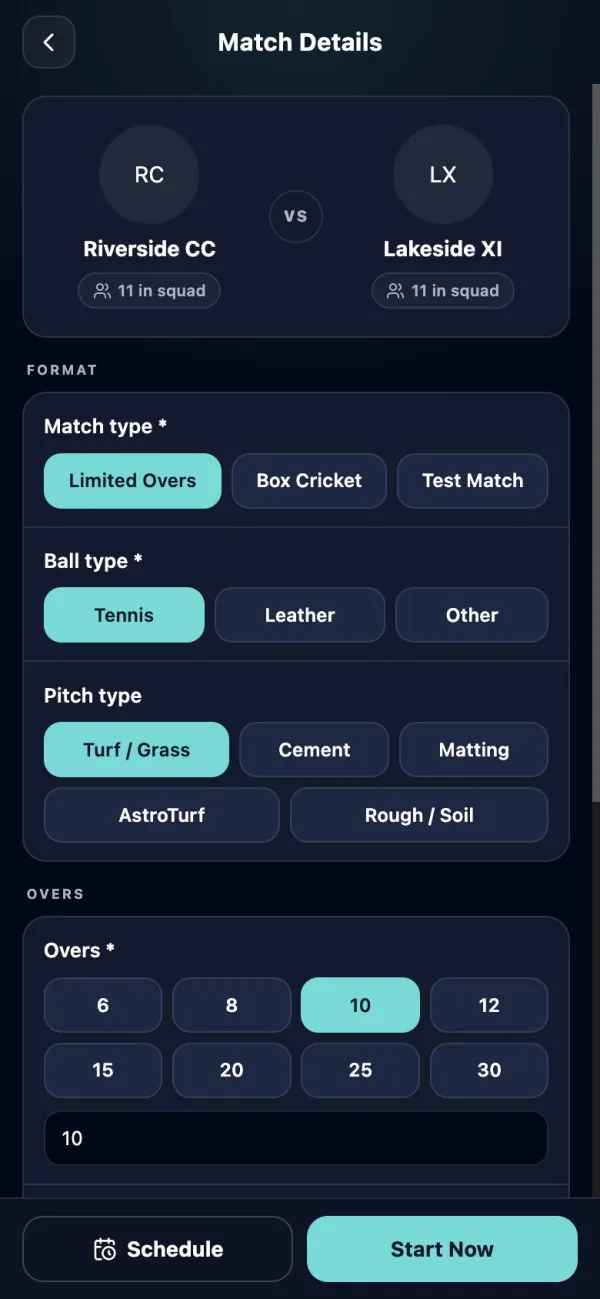
Paper scoring breaks down quickly in a box. Overs fly by, extras get bowled again and net runs change the total in a hurry. Criconic has a separate Box Cricket match type built for it:
- Your house rules: set any number of overs and an optional power play, and choose whether wide runs and no-ball runs count. You can turn on last man stands, and add bonus or penalty runs for either side when your rules call for it.
- A wagon wheel drawn as the box: instead of an oval ground, the shot tracker shows the front wall, the off-side net, the leg-side net and the back net. You tap where the shot went, and tap the runs your net rules give.
- A pitch map of where each ball landed, from yorkers to short balls.
- Super overs: if the scores finish level, start a super over from the scorer screen, or declare the match tied.
- A live link: share the scorecard in your group and it updates ball by ball. It opens in any browser, with no login.
- Stats that count: every box match adds to each player's career runs, wickets and averages. Scoring, scorecards and stats are free.
See how it works on the box cricket scoring app page, or start a box match before your next slot.
Questions
How many players are there in box cricket?
Usually 6 to 8 a side. Leagues often allow one or two substitutes, who can field but not bat or bowl.
How many overs are there in a box cricket match?
Most matches are 5 to 8 overs an innings, set by the length of the booked slot. Each bowler is usually limited to 1 or 2 overs.
Is a catch off the net out in box cricket?
Usually not. A catch taken after the ball touches a side net, the far net or the back net is not out in most leagues. Some leagues make an exception for a catch taken straight off the roof net.
What happens if the ball hits the roof in box cricket?
It depends on the venue. Common versions are a dead ball, or play on with the batter out only if a fielder catches the ball straight off the roof. A ball stuck in the roof net is a dead ball and is bowled again.
Is LBW out in box cricket?
Usually no. Most box cricket leagues don't give LBW, but bowled, caught, run out, stumped and hit wicket all count.
Is box cricket bowling underarm or overarm?
Both are common. Many leagues insist on underarm bowling from below the waist because the box is so small. Others allow overarm. Agree it before the match.