
Net Run Rate (NRR) Calculator: Formula and Worked Examples
Free net run rate calculator for any number of matches. Learn the NRR formula, the all-out and overs rules, and work through a full example step by step.
Net run rate (NRR) decides more tournament places than anything else in cricket. When two teams finish on the same points, the one with the higher NRR goes through. It is simple maths, but two small rules trip up almost everyone who works it out by hand.
This page has a free net run rate calculator for any number of matches, the formula, a worked example, and the mistakes that put local points tables wrong.
Net run rate calculator
It starts with the worked example below. Replace it with your own matches.
Net run rate calculator
Enter each league match your team has played. Write overs as overs.balls, like 17.3. Tick “all out” when a side was bowled out before its overs ran out.
The net run rate formula
NRR is how fast a team scores, minus how fast its opponents score against it, across every match it has played in the league:
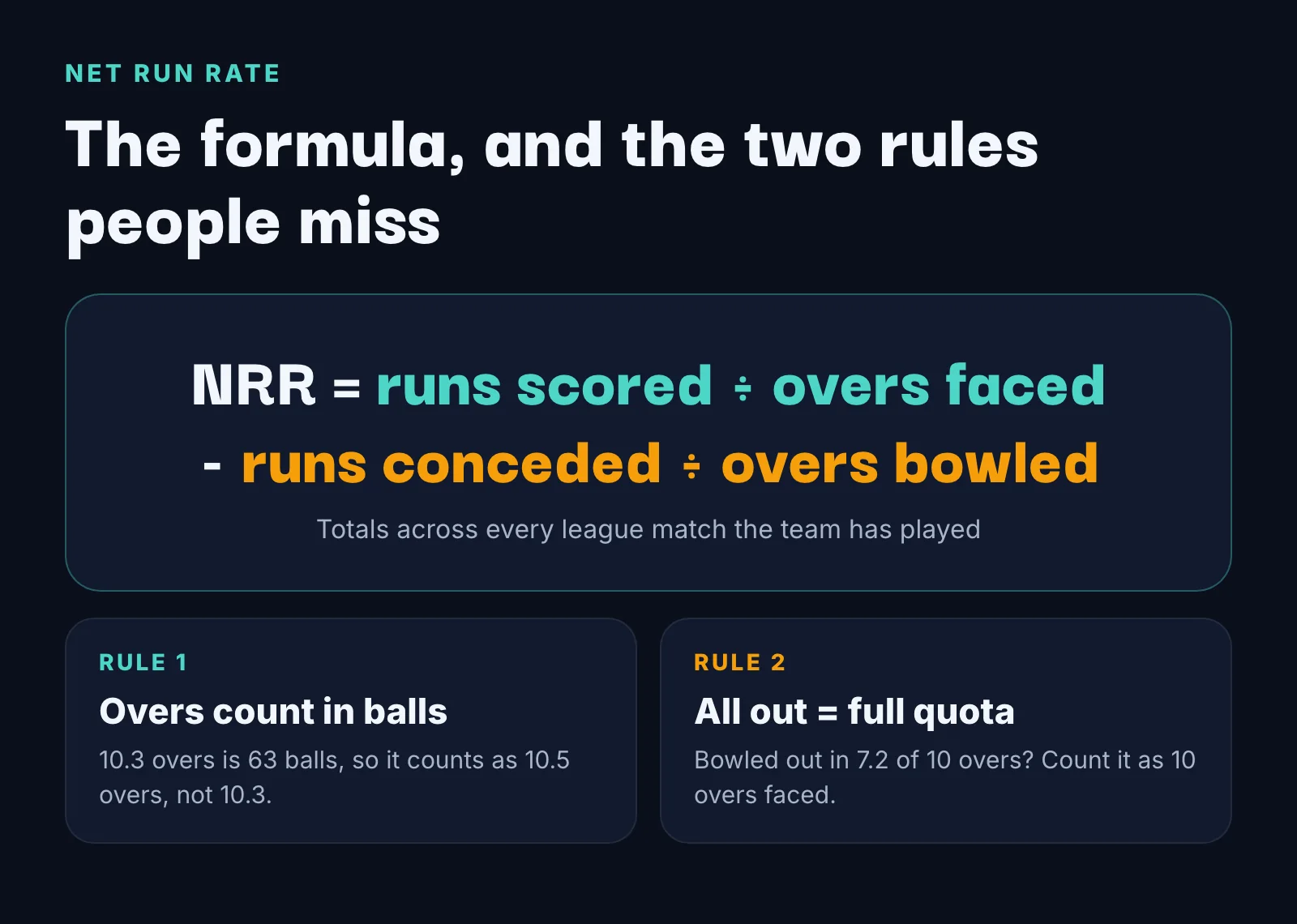
Rule 1: overs are counted in balls
An over has six balls, so 10.3 overs means 10 overs and 3 balls: 63 balls, which is 10.5 overs in the maths. Dividing by 10.3 gives the wrong answer.
Rule 2: all out means the full quota
If a team is bowled out before its overs are up, it is treated as having faced its full overs. A side all out for 120 in 17.3 overs of a 20-over match counts as 120 runs in 20 overs. Otherwise a team would be rewarded for getting bowled out quickly.
How to calculate net run rate: a worked example
Team A has played three 20-over league matches:
| Match | Team A batting | Team A bowling |
|---|---|---|
| 1 | 160/6 in 20 overs | 140/8 in 20 overs |
| 2 | 120 all out in 17.3 overs (counts as 20) | 121/4 in 18.4 overs |
| 3 | 175/5 in 20 overs | 150 all out in 19.1 overs (counts as 20) |
- Runs scored: 160 + 120 + 175 = 455, off 20 + 20 + 20 = 60 overs. That's 455 ÷ 60 = 7.583 runs an over.
- Runs conceded: 140 + 121 + 150 = 411, off 20 + 18.4 + 20 overs. 18.4 overs is 112 balls, or 18.667 overs, so the total is 58.667 overs. That's 411 ÷ 58.667 = 7.006 runs an over.
- NRR = 7.583 − 7.006 = +0.578.
Use totals, not each match's NRR
A common shortcut is to work out NRR for each match and then add or average them. That isn't how NRR works. For Team A, the three single-match NRRs are +1.000, −0.482 and +1.250. Adding them gives +1.768, and averaging gives +0.589. Neither matches the real figure of +0.578, because the matches weren't all the same length. Always add up the runs and the overs first, then divide.
Net run rate for a single match
For one match the formula is the same. In match 1, Team A scored 160 in 20 overs (8.00 an over) and conceded 140 in 20 overs (7.00 an over), so its NRR from that match alone is +1.000. In a completed match the winner's NRR from it is positive, and the loser's is the same number, negative.
Special cases
- Abandoned matches with no result don't count towards NRR.
- Rain-reduced matches: under ICC rules, when a chase target is revised by the DLS method, the team batting first is credited with the revised target minus one, off the overs the chasing team was given.
- Super overs don't count. NRR uses the main match only.
- Knockout matches usually aren't counted either. NRR is for separating teams in the league stage.
How to improve your NRR
- Win big: a 60-run win does far more than a 6-run win.
- Chase quickly: winning with overs to spare means you faced fewer overs for your runs.
- Bowl teams out: they are charged the full quota, which drags their scoring rate down.
- Avoid heavy defeats, even when the match is already lost.
Let the points table work it out
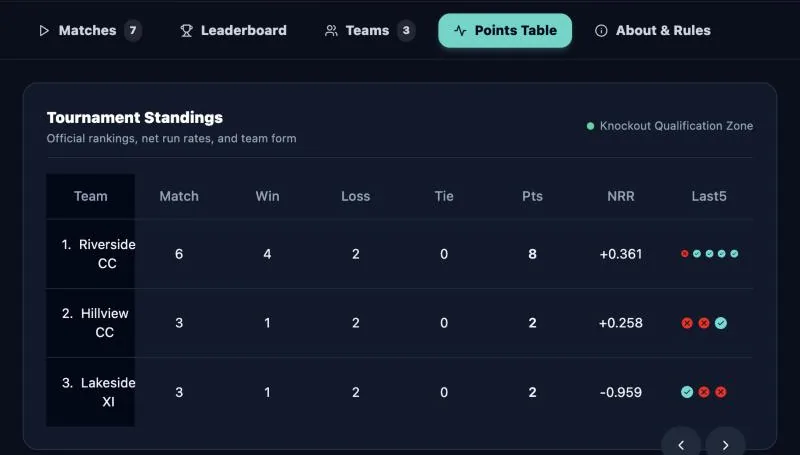
On Criconic, the tournament points table works NRR out the ICC way after every league match: totals across matches, overs counted in balls, and the full quota for a side that was bowled out. Knockout matches don't count, and teams are sorted by points, then NRR.
See how to set one up in our tournament tutorial, or read how to organise a cricket tournament for points systems and tie-breakers.
Questions
How is net run rate calculated?
Add up all the runs a team has scored and divide by all the overs it has faced, then subtract all the runs scored against it divided by all the overs it has bowled. Overs count in balls, and a team bowled out counts its full quota of overs.
How is NRR calculated when a team is all out?
The team is treated as having faced its full quota of overs. A side all out for 120 in 17.3 overs of a 20-over match counts as 120 runs in 20 overs.
How do you calculate net run rate for multiple matches?
Add the runs and overs from every match first, then divide. Don't add or average each match's NRR: that gives a different, wrong answer when matches have different lengths.
What does 10.3 overs mean in NRR?
10 overs and 3 balls, which is 63 balls, or 10.5 overs. Always convert overs to balls before dividing.
Is a positive NRR good?
Yes. A positive NRR means a team scores faster than its opponents score against it. The higher, the better when teams finish level on points.