
Strike Rate, Economy Rate and Average in Cricket: Formulas and Calculator
Cricket stats formulas with examples: batting average, strike rate, bowling average, economy rate, bowling strike rate and run rate, plus a free calculator.
Strike rate, economy and average are the numbers every cricketer gets judged on, from the IPL down to Sunday league. Each one answers a simple question: how many runs, how quickly, and at what cost.
This guide gives the formula for each, a worked example from a real player profile, rough benchmarks for what counts as good, and a calculator to work out your own.
Cricket stats calculator
Cricket stats calculator
Change any number to recalculate. Overs are written as overs.balls, so 23.4 is 23 overs and 4 balls.
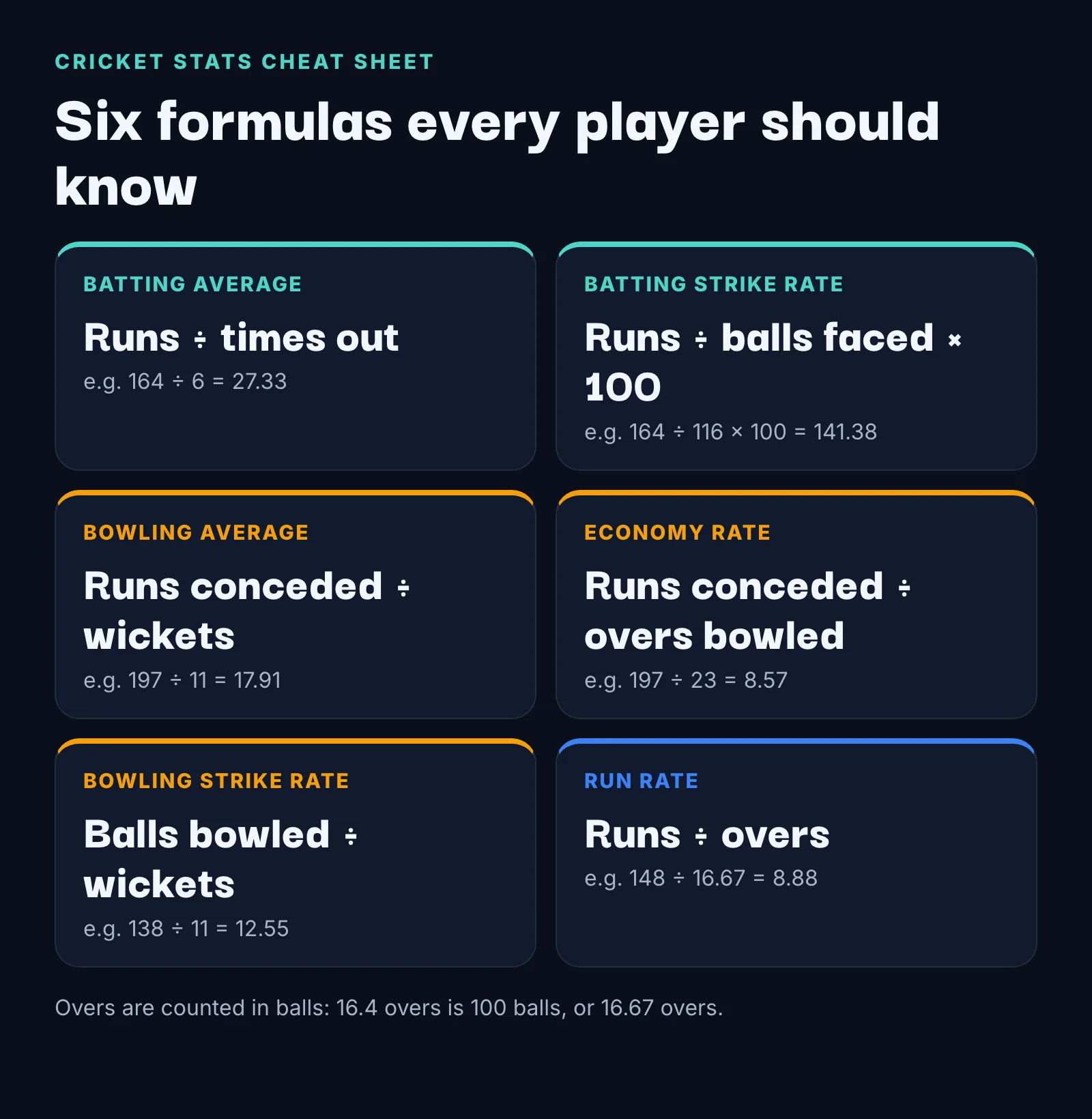
All six formulas at a glance
Batting average
Batting average = runs ÷ number of times out. It tells you how many runs a batter scores, on average, before getting out.
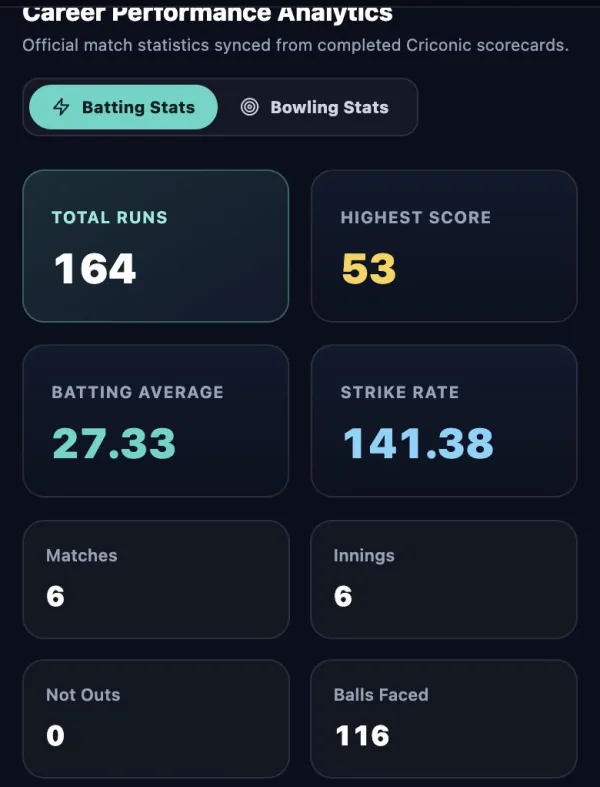
The sample player in our screenshots has 164 runs from 6 innings, and was out in all 6. Their average is 164 ÷ 6 = 27.33.
- Not outs don't count as dismissals. If they had been not out twice, the average would be 164 ÷ 4 = 41.00, even though they batted six times.
- A batter who has never been out has no average yet.
Batting strike rate
Strike rate = runs ÷ balls faced × 100. It is the runs a batter would score off 100 balls: a measure of speed, not just volume.
164 runs off 116 balls is 164 ÷ 116 × 100 = 141.38. Wides don't count as balls faced, but no-balls do.
Bowling average
Bowling average = runs conceded ÷ wickets. It is the runs a bowler gives away for each wicket, so lower is better.
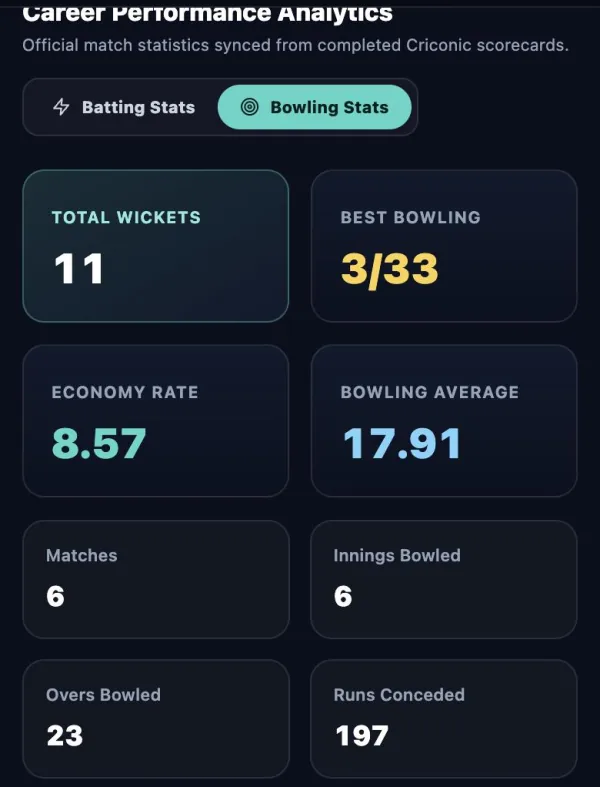
The same player conceded 197 runs for 11 wickets: 197 ÷ 11 = 17.91.
Economy rate
Economy rate = runs conceded ÷ overs bowled. It is the runs a bowler gives away per over. Lower is better.
197 runs off 23 overs is 197 ÷ 23 = 8.57 an over. If they had bowled 23.3 overs, that's 141 balls, or 23.5 overs, so the economy would be 197 ÷ 23.5 = 8.38. Never divide by 23.3.
Byes and leg byes aren't charged to the bowler, so they aren't in the runs conceded. Wides and no-balls are.
Bowling strike rate
Bowling strike rate = balls bowled ÷ wickets. It is how often a bowler takes a wicket. Lower is better.
23 overs is 138 balls, so 138 ÷ 11 = 12.55 balls per wicket: a wicket roughly every two overs.
Run rate and required run rate
Run rate = runs ÷ overs. A team on 148 after 16.4 overs has faced 100 balls, or 16.67 overs, so its run rate is 148 ÷ 16.67 = 8.88.
Required run rate = runs still needed ÷ overs left. Needing 30 off 14 balls is 30 ÷ (14 ÷ 6) = 12.86 an over.
Across a whole tournament, run rates feed into net run rate, which separates teams level on points.
What counts as a good strike rate or economy?
It depends on the format. As a rough guide for adult cricket:
| Format | Good batting strike rate | Good economy rate |
|---|---|---|
| T20 and shorter | 130 and above | Under 8 |
| One-day (50 overs) | 90 and above | Under 5 |
| Multi-day / Test | 50 to 60 is normal | Under 3 |
Tennis ball and box cricket run higher, so compare players within the same kind of cricket. A bowler's economy in box cricket can't be compared with one in 50-over cricket on grass.
Track your stats automatically
Every match scored on Criconic updates each player's career record: runs, averages, strike rates, wickets, economy, best figures, 30s, 50s and 100s, ducks and wicket hauls. Tournaments get their own leaderboards too. Seeing your stats is free.

Start with how to make a cricket scorecard.
Questions
What is strike rate in cricket?
For a batter, strike rate is the runs scored per 100 balls faced: runs ÷ balls × 100. For a bowler, it is the number of balls bowled per wicket: balls ÷ wickets.
How is economy rate calculated in cricket?
Economy rate = runs conceded ÷ overs bowled. Convert overs to balls first: 23.3 overs is 141 balls, or 23.5 overs. Byes and leg byes aren't charged to the bowler.
What is the formula for batting average?
Batting average = runs ÷ number of times out. Not-out innings add runs but not dismissals, so they push the average up.
What is a good economy rate in T20 cricket?
As a rough guide, under 8 runs an over is good in T20. In 50-over cricket, under 5 is good.
What is the difference between bowling average and bowling strike rate?
Bowling average is runs conceded per wicket (cost). Bowling strike rate is balls bowled per wicket (frequency). Lower is better for both.